4 Things I learned at GSX 2026 That Every Security Leader Should Know
4 Things I Learned at GSX 2026 That Every Security Leader Should Know
September 29, 2026
Authored by Billy Borho, Director of Sales, Shooter Detection Systems
I have been attending GSX for a long time. Every year I walk away with a read on where the industry is headed, what security leaders are thinking about, and what questions are keeping them up at night. This year felt different. The conversations at our booth, the demand for our tours, and the people I met in Atlanta told me something I have been watching build for a while is now fully here.
Here is what I took away from GSX 2026.
- The Question Has Changed
For years, the first conversation I had with a security leader about gunshot detection started in the same place: “Do we need this?” It was a question about whether gunshot detection belonged in their security program at all. That question is largely gone.
At GSX 2026, the conversation had moved. Security leaders were not asking whether to implement gunshot detection. They were asking how, as in:
- How do we phase this in?
- How does it integrate with what we already have?
- How do we make the case to our board?
That shift tells me something important: gunshot detection has crossed a threshold. It is no longer an emerging technology being evaluated by early adopters. It is becoming expected and mission critical infrastructure, following the same arc as fire alarms, access control and video surveillance.
Over the five-year period from 2020 to 2024, commerce and open space locations accounted for 80% of all active shooter incidents in the United States. Security leaders have seen that data. They know that traditional systems, video surveillance, access control, panic buttons, were never designed to detect a shooting in progress or trigger an immediate response on their own. Gunshot detection closes that gap. My conversations at GSX 2026 with security leaders, service providers/ integrators, and security consultants affirmed a shared understanding of the importance of gunshot detection as a technology to address this gap.
- Executive Protection Is Driving New Investment
Something else stood out in Atlanta: the level of the conversation. I was not just talking to facility managers and security directors. I was talking to CSOs, VPs of corporate security, and in several cases, people who report directly to the board. Gunshot detection has moved up the priority stack.
What is driving this? Corporate enterprises are increasingly focused on executive protection as part of their broader active shooter preparedness programs. The C-suite is no longer assumed to be insulated from the threat. Organizations are thinking about the buildings their executives and employees work in, the campuses they operate on, the events they attend, and even their homes. Gunshot detection is part of that conversation in a way it was not two or three years ago.
The organizations I spoke with at GSX were not just talking about protecting their facilities. They were protecting their people at every level of the organization, and they were budgeting for it accordingly. That is a meaningful change in how this technology is being positioned internally, and it is opening doors that were not open before.
- Nothing Sells Like Seeing It for Real
This year at GSX, SDS did something I am genuinely proud of. The Georgia World Congress Center, the building hosting the conference, has been an SDS customer since 2018. It protects nearly 4 million square feet, welcomes more than a million visitors each year, and runs one of the most sophisticated security operations of any public venue in North America.
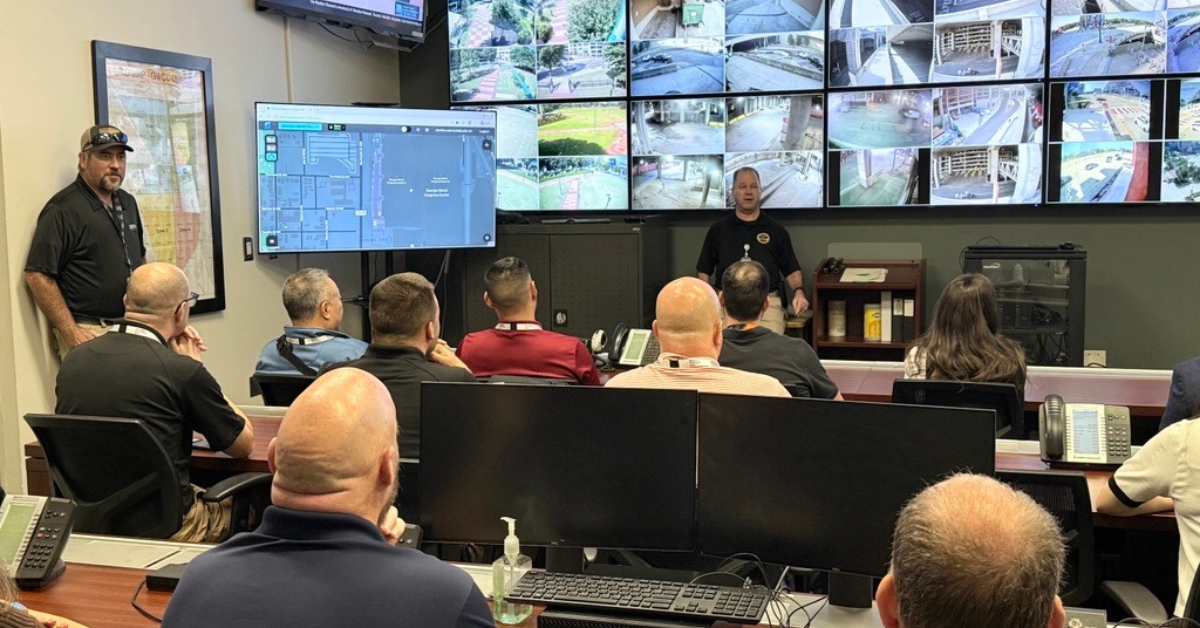
On Tuesday, September 15th, we hosted exclusive behind-the-scenes tours of the GWCC’s live gunshot detection installation and Emergency Operations Center. We planned for two sessions. Demand required a third. In total, more than 150 security leaders and consultants walked a live installation, stepped inside an active EOC, and heard directly from Marc Vincent, the GWCC’s Director of Emergency Preparedness, on how his team uses gunshot detection as part of a fully integrated security program. What made those tours valuable was what Marc shared about his program.
Marc provided in-depth perspective about how the GWCC approaches active shooter preparedness from the ground up: how his team trains, how they run live-fire exercises including simultaneous multi-weapon discharge scenarios, how they coordinate with the Atlanta Police Department, federal law enforcement, and intelligence partners, and how gunshot detection fits into a layered response protocol that has been stress-tested against real-world scenarios. In a room full of peers facing the same challenges, that candor was worth more than any case study or product demonstration we could have offered.
I watched security leaders in that EOC lean forward, take notes, and ask Marc questions they would never ask a vendor, because they were talking to someone who has built and run the program they are trying to build. That is a different kind of conversation entirely.
Marc Vincent did not sell anyone on gunshot detection. He just told them the truth about his program. That is more powerful than anything I could say from behind a booth counter.
The lesson for our industry: peer-to-peer learning is underutilized. If you are a security leader who has deployed gunshot detection and you are willing to share your experience with peers, that conversation is worth more than any marketing material we could produce. We will be looking for more ways to create those moments.
- The Perimeter Is the Next Frontier, and the Market Knows It
At GSX, the fourth signal I kept hearing was outdoor gunshot detection, and not just curiosity. Security leaders were asking specific, informed questions about perimeter protection, parking lot coverage, campus boundaries, and how outdoor detection integrates with existing infrastructure.
SDS Perimeter, our outdoor gunshot detection system, uses the same multi-factor acoustic and infrared detection approach as our indoor system, with machine-learning algorithms developed specifically for the acoustic complexity of outdoor environments. Between wind, traffic, aircraft, crowds, and construction, the complexity outdoors is real. The system must distinguish a gunshot from all that noise reliably and in real time.
The field results speak for themselves. In one deployment, SDS Perimeter sensors helped law enforcement respond to a drive-by shooting in under three seconds, providing real-time location data, vehicle speed, direction of fire, and firearm type. In another, over a July 4th holiday weekend, the system processed more than 1,700 loud acoustic events, mostly fireworks. When a real gunshot occurred in the middle of that noise, the system flagged it. Law enforcement made an arrest in under ten minutes.
The conversations at GSX told me the market is ready for this. Organizations that have already deployed indoor gunshot detection are asking about their perimeters. Organizations that are just starting their evaluation are thinking about indoor and outdoor from the beginning. That is a significant shift from two years ago, when outdoor detection was still largely a future consideration for most buyers.
The threat does not stop at the front door. The market has figured that out, and we are ready to meet it.
What This Means for Security Leaders
GSX 2026 gave me a clear picture of where this industry is headed. Gunshot detection is moving from optional to essential. Executive protection is elevating the conversation to the board level. Peer-to-peer learning is the most powerful tool we have for accelerating adoption. And the perimeter is the next deployment frontier.