Public Venue Gunshot Detection
From the first shot, SDS delivers automated gunshot detection in under one second — with 50+ integrations that connect your entire security infrastructure for faster, more coordinated response. Protect every fan, staff member and first responder – from the first shot. SDS delivers real-time gunshot detection purpose-built for stadiums and public venues — sub-second alerts to facility security teams and 911, with near-zero false alarms and no audio recording.
Built for the noise, scale, and complexity of stadiums and large venues
Not all gunshot detection systems are built the same. Some count machine learning as a separate detection “factor”, but machine learning is a processing method, not an independent physical signal. SDS goes beyond acoustic gunshot detection by requiring two genuinely distinct physical phenomena: the acoustic muzzle blast and the infrared muzzle flash must both be present simultaneously before an alert is issued. Machine learning enhances signal processing on top of that dual-physical confirmation, delivering the accuracy and speed that single-phenomenon systems cannot match.
Why large venues need real-time gunshot detection
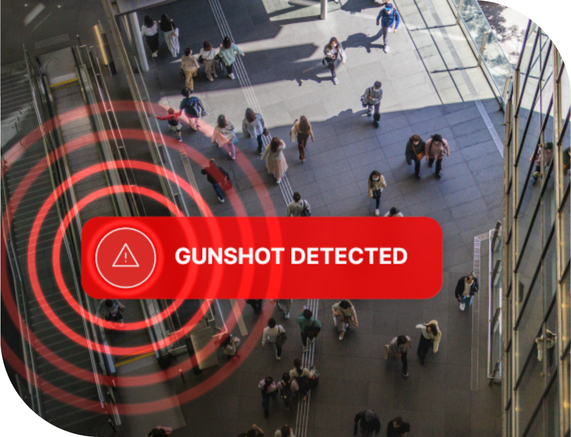
High crowd density demands an instant, automated response
Stadiums and arenas concentrate tens of thousands of people in a single footprint with multiple entry points, open concourses, and exterior gathering spaces that extend well beyond the gates. In environments this complex, manual threat identification isn’t fast enough. Venue gunshot detection removes human hesitation from the equation entirely, pinpointing the exact location of a shot and triggering a coordinated response before most bystanders have processed what happened.
Traditional security doesn’t close the response gap fast enough
Walk-through weapons screening systems secure entry points, but they don’t cover parking structures, tailgating areas, or the concourses where fans move freely during events. When a shot is fired, CCTV and security patrols depend on someone witnessing the event, processing it under extreme stress, and manually escalating the alert. The average venue takes 4.2 minutes to get a first responder on scene. The best venues achieve a response time of 1.8 minutes. That gap is closeable with the right technology.
Built for the noise, scale, and complexity of stadiums and large venues
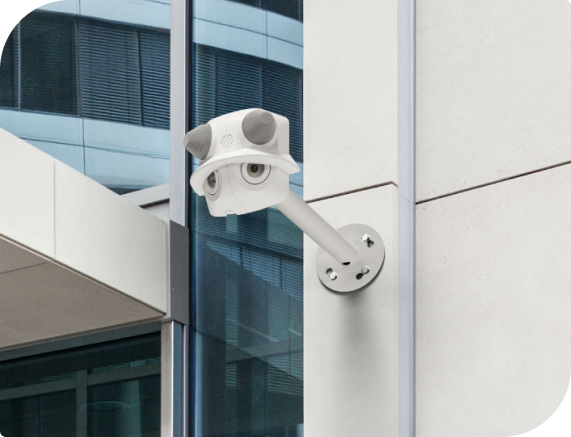
Multi-factor gunshot detection using acoustic, infrared, and machine learning
Some gunshot detection systems count machine learning as a separate detection “factor”, but machine learning is a processing method, not an independent physical signal. SDS goes beyond acoustic gunshot detection by requiring two genuinely distinct physical phenomena: the acoustic muzzle blast and the infrared muzzle flash must both be present simultaneously before an alert is issued. Machine learning enhances signal processing on top of that dual-physical confirmation, delivering the accuracy and speed that single-phenomenon systems cannot match.
99.9% detection rate
SDS detects gunfire with 99.9% accuracy, a figure validated by independent third-party testing, including an 18-month evaluation by the UK’s National Protective Security Authority, which recorded a 99.9% detection rate and a 0% false alert rate. That same performance standard has been confirmed across billions of aggregate operational sensor hours at more than 500 customer sites worldwide.
Fast detection (<1 second)
In an active shooter event, every second counts, making time the toughest variable to control. SDS detects gunfire in under one second indoors and under three seconds outdoors, automatically pinpointing the shot location on a site map while simultaneously alerting security staff and law enforcement. Integrated systems automate video surveillance, access control, and mass notification. For teams managing fragmented systems, that speed is the difference between a coordinated response and chaos.
Near-zero false alarm rate
The average cost of a false alarm at a major venue is around $78,000 per incident. At that price, venue security directors evaluating gunshot detection systems should treat false alert rate as a key financial and operational risk metric. SDS generates fewer than one false alert per 5 million hours of sensor use, giving security directors a system they can act on immediately and with confidence.
Advanced tech. Simple to deploy.
Scalable sensor coverage — indoor and outdoor
Start with one or a few sensors and our software, then scale coverage across concourses, suites, parking structures, and exterior gathering places as needed.
Plug-and-play installation
Quick and easy installation with no calibration required. Minimal disruption to venue operations from day one.
Automatic eyes on the scene with video integration
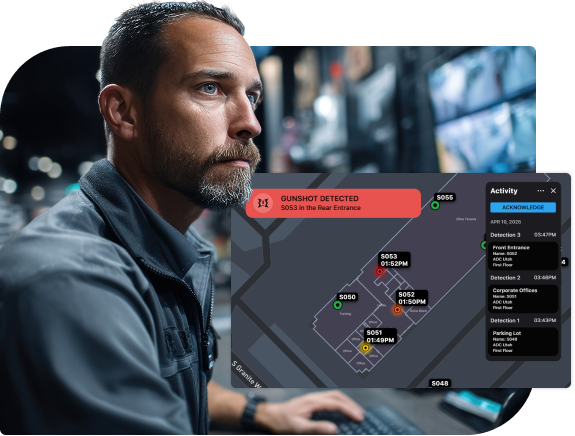
The moment a shot is detected, we can direct your cameras to the exact location of gunfire, giving your security team a live view within seconds.
Instant alerts to staff, security, and 911
Simultaneous SMS, email, and integrated mass notifications reach the right people at the right time, while ResponderLink routes the exact shot location to the nearest 911 dispatch center.
+24/7 automated health checks
Real-time sensor diagnostics with automated maintenance alerts keep the system verified and ready at every event.
Technology Partners
SDS works with the security infrastructure you already have. 81% of stadium security directors cite fragmented systems as their top operational pain point, so we understand how important integration is for seamless security operations at venues. With 50+ certified integrations across leading video management, access control, and mass notification platforms, every shot detected triggers an immediate, coordinated response across your entire security stack.
DHS SAFETY Act Certified
DHS SAFETY Act Certification is the federal government’s highest standard for anti-terrorism security technology. SDS is the only gunshot detection system that holds the highest level of certification. For venues pursuing a proactive gun violence prevention strategy — or their own SAFETY Act Certification — deploying certified technology strengthens your application, your legal posture, and your ability to demonstrate a proactive commitment to public safety. It also documents security investment to leadership and insurers. That certification is not an award, it’s earned through independent evaluation, and it stands as the most credible third-party validation of product performance in the industry.
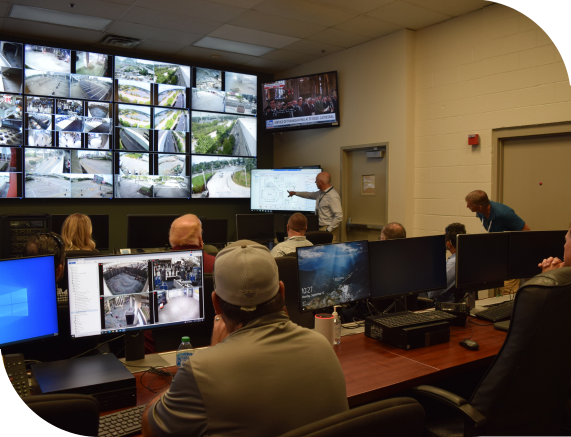
How SDS protects the Georgia World Congress Center
North America’s third-largest exposition center, the Georgia World Congress Center, covers 3.9 million square feet and hosts over one million visitors annually, including NFL game day crowds from the adjacent Mercedes-Benz Stadium. The GWCC deployed the SDS Indoor Gunshot Detection System across key gathering areas and building access points, integrating directly with their Avigilon video surveillance system for instant visual identification and tracking. Live fire exercises confirm the system’s ability to detect simultaneous discharges from multiple weapons and transmit precise location data to law enforcement via text, email, and video.
Public Venue and Stadium gunshot detection systems FAQ
Does the system work in loud, crowded environments?
SDS was purpose-built to work in acoustically challenging environments and isn’t fooled by sounds that the human ear might mistake for gunfire. The technology traces its lineage to the Boomerang sniper detection system, developed for U.S. military use in Iraq and Afghanistan, where acoustic complexity and the cost of error were both extreme. That same engineering discipline now underpins SDS’s commercial systems, which have accumulated billions of aggregate operational hours across more than 500 customer sites worldwide, and the performance record reflects it.
How does SDS reduce false alarms in venues?
SDS reduces false alarms in venues through multi-mode detection, requiring simultaneous confirmation from two independent physical phenomena — acoustic muzzle blast and infrared muzzle flash — before issuing any alert. Crowd noise, pyrotechnics, PA systems, and concourse activity all create a constant backdrop of high-decibel sounds that less advanced systems may struggle with. SDS generates fewer than one false alert per five million hours of sensor use, giving security directors a system they can act on immediately with confidence.
Can the system connect to our existing security infrastructure?
Yes. Integration capability is noted as the #1 technology feature venue security directors prioritize, yet only 28% report they have a unified system in place. SDS was designed to close that gap. With 50+ certified integrations across leading security platforms, SDS connects directly to your existing video management systems, access control, and mass notification platforms. When a shot is detected, your entire security infrastructure can respond in concert, with no manual, error-prone coordination required. SDS functions as a force multiplier for the security investments you have already made.
What happens when a shot is detected?
Within seconds of detection, SDS simultaneously executes a coordinated response across your security infrastructure. The shot location is pinpointed on a floor plan and pushed to security staff via the SDS software platform, plus SMS and email notification. With integration, cameras automatically lock on to the exact location of the detected shot, giving your team a live view within seconds. ResponderLink routes the precise location directly to the nearest 911 dispatch center, eliminating the delay and misinformation that typically accompany manual emergency calls. Access control and mass notification systems trigger automatically. When a shot is detected, your team receives confirmed, actionable intelligence, and law enforcement is already en route.