Gunshot Detection for College and University Campuses
A college campus is a fundamentally different security environment than a single building. Dozens of academic buildings, residence halls, athletic facilities, parking structures, and open quads spread across hundreds of acres — often with public streets running through them — require a strategy that can detect gunshots indoors and outdoors, across every structure, on one unified platform. SDS delivers dual-factor indoor detection and SDS Perimeter outdoor coverage together, backed by DHS SAFETY Act Certification, four consecutive Secure Campus Awards, and sub-1-second indoor alert speed.
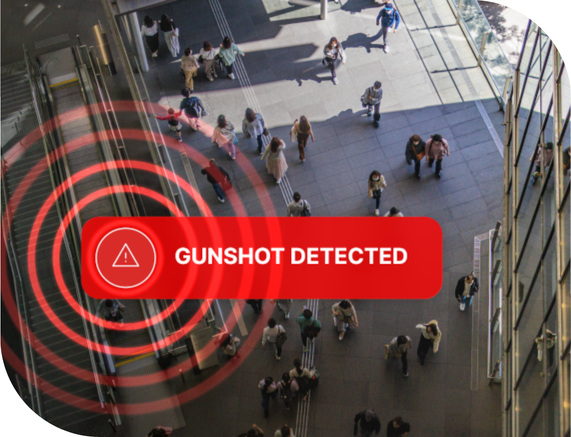
College campuses face a security gap a single building-based system can’t close
Gun violence on a college campus can unfold in any building or on open grounds, and a security system has to cover both. The three challenges below show where single-layer systems fall short.
A campus has dozens of buildings, not one
A college campus is a fundamentally different security environment than a single building. Dozens of academic buildings, residence halls, athletic facilities, parking structures, and open quads spread across hundreds of acres, often with public streets running through them, require a detection strategy that works both indoors and outdoors, protecting critical structures. SDS delivers exactly that, providing both indoor and outdoor coverage working together so campus security teams get reliable, actionable information in seconds.
Acoustic-only detection struggles with both dense interiors and open outdoor grounds
Dining halls, gyms, and residence halls generate constant ambient noise that makes acoustic-only detection unreliable indoors. Outdoors, wind, traffic, and distance compound the problem. SDS uses dual-factor detection, requiring both an acoustic muzzle-blast signature and an infrared muzzle-flash signature simultaneously before any alert is generated. A loud noise alone cannot trigger the system. This approach gives SDS sensors a 99.9% detection rate and fewer than one false alert per five million hours of use, figures validated by the UK National Protective Security Authority in an independent 18-month evaluation of the SDS indoor system. Privacy is critical, so unlike other acoustic only systems, no conversations are captured, no audio is stored, and no personal data is collected.
Open campuses make timely, verified alerts a compliance obligation, not just a nice-to-have
Colleges and universities in the United States that receive federal student aid are subject to the Clery Act, which requires institutions to issue timely warnings and emergency notifications when a confirmed threat occurs on or near campus. A key component of that obligation relies on speed, accuracy and verification. SDS delivers sub-second indoor detection and outdoor detection in under-3-seconds. Our ResponderLink feature routes verified alerts automatically to campus police, administrators, and 911 dispatch simultaneously.

How gunshot detection supports a college’s Clery Act obligations
The Clery Act requires colleges and universities that receive federal student aid to issue timely warnings and emergency notifications when a confirmed threat, such as an active shooter, occurs on or near campus. Meeting that obligation depends on two things: verification and speed. A system that generates a high degree of false alarms, or one that requires a human to manually confirm and initiate security alerts, introduces delay at exactly the moment the law requires action.
SDS addresses both requirements directly. Dual-factor detection (acoustic and infrared) confirms a gunshot before any alert is sent, significantly reducing the false alarm problem that undermines confidence in acoustic-only systems. Once confirmed, ResponderLink routes verified alerts simultaneously to campus police, administrators, and 911 dispatch, removing the reporting burden when people are trying to come to terms with the unfolding crisis. Sub-second indoor and under-3-second outdoor detection times mean the notification chain starts before most witnesses have processed what they heard.
For colleges and universities, automated, verified detection is part of a direct operational response to a legal requirement.
Acoustic + infrared multi-factor detection, indoors and out
Every SDS sensor requires two simultaneous physical signals to confirm gunshots fired: an acoustic muzzle blast registered by acoustic sensors and an infrared muzzle flash registered by infrared sensors. A sensor will not alert on either signal alone, which is what keeps false alert rates below one per five million hours of indoor use.
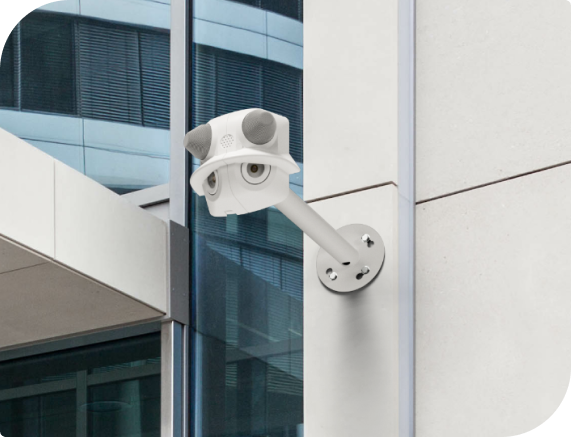
Indoor sensors mount flush to walls or ceilings, require no calibration, and cover a minimum of 2,500 square feet each. They are available in PoE or wireless configurations, with the wireless version communicating over a LoRa network with AES encryption. Privacy is assured as no audio is recorded or transmitted; all detection processing happens inside the sensor.
SDS Perimeter extends the same dual-factor approach to outdoor campus environments, so a campus can detect gunshots on quads, in parking lots, and along building approaches. Each outdoor sensor covers a minimum of 15,700 square feet, mounts on a wall or pole at 12 to 16 feet, requires no triangulation or calibration and delivers confirmed alerts in under three seconds. A single outdoor sensor also reports shooter direction and range, giving campus security teams actionable location data from the moment of detection.
Both systems run on the same web-based platform so indoor and outdoor coverage appear in a single operational view.
Integrating with your campus’s existing security infrastructure
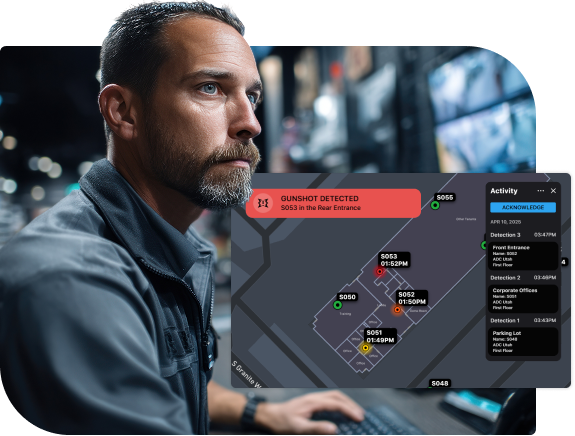
A gunshot detection system that operates in isolation from the rest of a campus’s security assets only delivers an alert. A system that integrates with that stack delivers an automated, coordinated response. SDS offers more than 50 manufacturer certified integrations with security platforms across video management, access control, and mass notification. When a gunshot is confirmed, SDS can automatically direct cameras to the detection location, trigger lockdown protocols through access control systems, and push alerts to campus security staff, administrators, and 911 dispatch simultaneously.
As one example SDS’s integration with Genea, a cloud-based access control platform, was developed with higher education specifically in mind. It combines instant gunshot detection with automated lockdown response across multi-building campuses, addressing the distributed physical footprint that makes manual coordination impractical under pressure.
For campuses with existing investments in systems like Genetec, Milestone, Avigilon, Everbridge, or Singlewire InformaCast, SDS works seamlessly with those infrastructures adding more value to the systems you may already use.

Does gunshot detection technology prevent college shootings?
Gunshot detection does not prevent an individual’s decision to commit gun violence. No single technology does. What it changes is what happens in the seconds after the first shot: who gets notified, how fast, and with what information.
For campus security teams, that distinction has real operational weight. SDS delivers a verified alert to campus police, administrators, and 911 dispatch simultaneously, with precise location data, before most witnesses have processed what they heard. That speed compresses the window between incident and informed response.
Detection technology is one layer in a broader security framework, alongside threat assessment programs, prevention policy, physical access controls, and staff training. Deploying it does not reduce the importance of those other layers. Rigorous long-term effectiveness studies on college campus gunshot detection are still limited, and security practitioners evaluating this technology should weigh that honestly. What the evidence does support is that faster, verified notification gives responders more time to plan and act.
College Gunshot Detection: Frequently Asked Questions
What is a university gunshot detection system?
A university gunshot detection system is a sensor-based technology that automatically identifies a firearm discharge and delivers real-time, verified alerts to campus security, administrators, and first responders. Without one, a campus may depend on witnesses calling 911 with reports of gunshots fired, a process that introduces delay, uncertainty about location, and no guarantee that the right people are notified at the same time. Campus systems should include both outdoor and indoor sensors that work in conjunction to track an active shooter’s movement across buildings or locations, providing first responders with the most accurate and up-to-date information.
How does gunshot detection support a college's Clery Act compliance obligations?
The Clery Act requires colleges and universities receiving federal student aid to issue timely warnings and emergency notifications when a confirmed threat occurs on or near campus. The speed and verification requirements embedded in that obligation are exactly what automated gunshot detection addresses. Manual reporting through 911 calls introduces delay and location uncertainty. SDS delivers a verified alert with precise location data to campus police, administrators, and 911 dispatch simultaneously, in under one second indoors and under three seconds outdoors, before a manual notification chain would typically begin.
How accurate is a university gunshot detection system, and how are false alarms prevented?
Accuracy in gunshot detection depends primarily on how a sensor detects and confirms a shot before sending an alert. Systems that rely on acoustic sensors alone have difficulty distinguishing a gunshot from other loud, impulsive sounds: a door slamming in a corridor, car backfires or fireworks, a pallet dropping in a loading dock, or even a drum at an athletic event. In a campus environment with dining halls, athletic grounds, and parking lots generating constant ambient noise, that is a significant challenge.
SDS uses dual-factor detection, requiring both an acoustic muzzle blast and an infrared muzzle flash to register before any alert is sent. Additional verification and machine learning are used to further verify the signals. The result, validated by the UK’s National Protective Security Authority in an independent 18-month evaluation, is a 99.9% detection rate and a 0% false alert rate for the indoor system. Outdoor performance follows the same dual-factor architecture, producing fewer than one false alert per one million operational hours.
What's the difference between indoor and outdoor gunshot detection on a college campus?
SDS Indoor sensors are designed for enclosed campus buildings: residence hall entrances, lab buildings, dining facilities, libraries, and athletic centers. Each sensor covers a minimum of 2,500 square feet, mounts flush to a wall or ceiling, and delivers a confirmed alert in under one second. No audio is recorded or transmitted.
SDS Perimeter addresses the outdoor campus environment: quads, parking lots, building approaches, and athletic grounds. Each outdoor sensor covers a minimum of 15,700 square feet, mounts on a wall or pole, and delivers a confirmed alert in under three seconds. A single outdoor sensor also reports shooter direction and range, giving campus security teams precise location data from the moment of detection.
How does a gunshot detection system integrate with a college's existing security operations?
When a gunshot is confirmed, a detection system needs to do more than send an alert. It needs to push that alert to the security systems campus security teams are already using. This can be accomplished through a direct API or a dry contact relay. SDS connects directly with leading video management systems, access control platforms, and mass notification tools through API-based integrations, meaning no additional hardware or relay devices are required. Campus security can then manage events from a single interface rather than switching between systems during an active event.
Does a gunshot detection system on campus record conversations or monitor students?
Privacy is an important issue for universities. Some vendors have developed acoustic-only systems that have recorded private conversations due to sensor placement or design. Some vendors have made personal data available to law enforcement without proper safeguards. A safety technology like gunshot detection should not be developed to record or transmit personally identifiable information or conversations. For these reasons, all SDS sensors are constructed in a way that does not collect or store conversations, images or other data not related to a gunshot signal. All detection processing happens inside the sensor itself. The only information transmitted from a sensor to the system is a simple text alert confirming a gunshot, along with its location. For campuses weighing faculty and student privacy concerns alongside security needs, this architecture is a meaningful distinction
Does gunshot detection technology prevent college shootings?
Gunshot detection does not prevent an individual’s decision to commit violence. No single technology does. What it changes is what happens in the seconds after the first shot: who gets notified, how fast, and with what information.
Is SDS certified for use in higher-education environments?
There is no industry or university specific certification for gunshot detection. However, since its founding in 2015, SDS has worked closely with the United States Department of Homeland Security, third party labs and other federal security agencies to test and certify its products. SDS holds the highest level of DHS SAFETY Act Certification available, first achieved in 2017 and renewed in 2023. SDS is the only gunshot detection manufacturer to hold this certification, which requires demonstrated, sustained performance and verification by its end users.